Vacuum feels soft. Top plies creep mid-cut. Edges look stepped even after a fresh blade. Many rooms chase CAM settings first. The quieter fault is often the cutting-table bed.
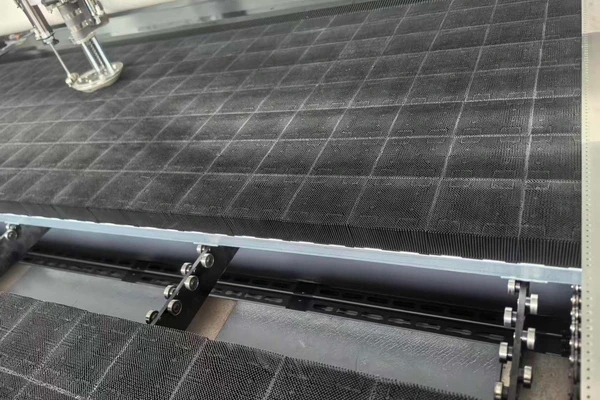
A bristle block is the modular filament pad that forms the vacuum bed on an automatic cutter. It seals hold-down air under the fabric stack and gives the knife a soft place to finish its plunge. When filaments flatten, bald out, or leave gaps, vacuum leaks and edges wander — even though the nest file did not change.
This pillar walks through what bristle blocks do, how vacuum sealing and blade plunge work, nylon vs polypropylene, when to replace them, how to match size and part number by brand, install and rotation habits, OEM vs aftermarket fit rules, and what to send Stak for a fast quote. Brand names such as Lectra, Gerber, and Bullmer describe compatibility only. Stak supplies compatible replacements and is not affiliated with those machine makers. Always confirm the underside base before you order.
Browse live listings on the bristle blocks hub and the bristle product category.
Key Takeaways
- A cutting-table bristle block seals vacuum under the stack and cushions the blade plunge so the knife does not hit a hard deck.
- Replace by wear signals (flattened, bald, soft, vacuum loss, wandering edges), not by a fixed month count.
- Nylon and polypropylene both appear in Stak listings; match footprint and base first, then choose material for duty and shop humidity.
- Match part number, machine model, L×W×H, and base shape (round foot vs square foot, perforated rim vs solid rim) — color is not a fit rule.
- Send references, model, measures, underside photos, quantity, and ship-to country for a Stak quote.
Table of Contents
- What Is a Bristle Block and What Does It Do?
- How Do Bristle Blocks Seal Vacuum and Protect the Blade Plunge?
- Nylon vs Polypropylene: Which Bristle Block Material Should You Choose?
- When Should You Replace Bristle Blocks?
- How Do You Match Bristle Block Size, Part Number, and Base Shape by Brand?
- How Do You Install, Rotate, and Maintain Bristle Blocks?
- OEM vs Aftermarket Bristle Blocks: What Actually Has to Match?
- What Should You Send to Get a Fast Bristle Block Quote?
- Frequently Asked Questions
What Is a Bristle Block and What Does It Do?
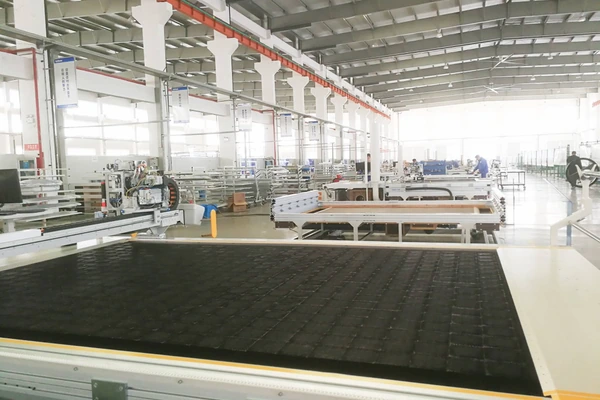
A bristle block is a modular pad of dense filaments that forms the cutting bed on an automatic cutter. It holds fabric with vacuum and cushions the knife as it plunges through the stack.
In one sentence for a new buyer: it is the soft vacuum brick under the fabric — not a grinding stone, not a handheld cutting mat, and not a carpet tile. On Lectra, Gerber, Bullmer, Yin, FK, Kuris, and similar automatic cutting tables, the bed is a grid of these blocks over vacuum ports. Filaments stand upright so air can pull the plies flat. When the knife drops, tips yield a few millimeters instead of chipping the blade or scarring a hard surface.
Think of three jobs at once:
- Vacuum seal — filaments pack close enough that air pulls down through the stack instead of leaking sideways.
- Blade plunge support — the knife finishes its stroke in soft bristle, not on metal or wood.
- Surface support — small parts and tight curves need a firm, even field so notches and edges stay true.
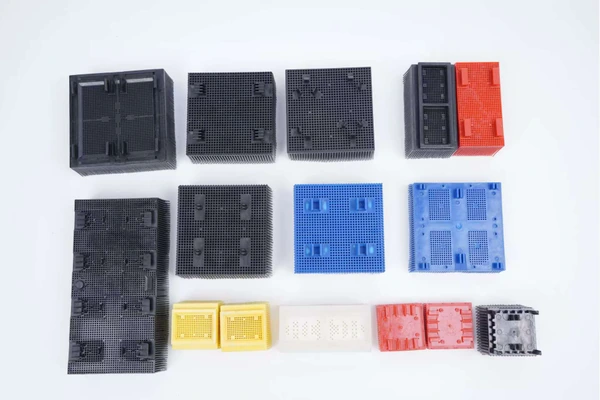
Color alone does not tell you the model. Two blocks that look the same on top can hide different base feet underneath. Stak stocks nylon and polypropylene (often listed as Poly/PP) styles linked to common cutter families. Start from the bristle blocks page or the bristle category, then confirm the reference on your old block.
How Do Bristle Blocks Seal Vacuum and Protect the Blade Plunge?
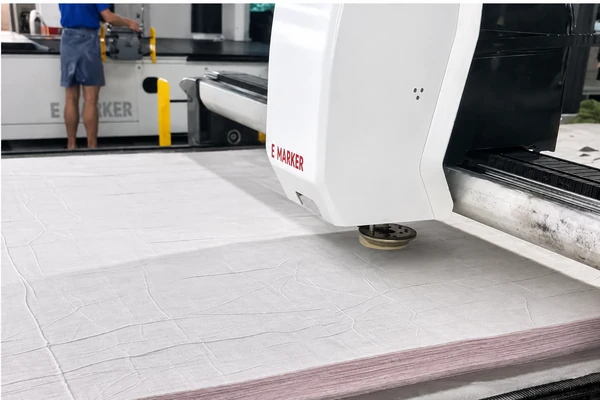
Bristle blocks seal vacuum by packing upright filaments over the table ports so air holds every ply; they protect the blade by letting the tip finish its stroke in soft bristle instead of on a hard deck.
Vacuum fans under the table pull air through holes in the frame. Intact bristles sit above those holes like a dense brush. When the cover film and fabric are in place, the stack becomes the “lid.” Air has nowhere easy to escape, so hold-down force rises. Flattened or missing filaments open leak paths. Top plies then creep mid-cut even though the nest file did not change.
Blade plunge works the other way. The cutter lowers the knife through the full stack height, then a short distance past the fabric underside. That extra travel must land in bristle. If the bed is bald or collapsed, the tip can flex, chatter, or strike a hard insert. Cut edges look dull or stepped even with a fresh grind.
What a healthy bed feels like
| Check | Healthy bed | Problem bed |
|---|---|---|
| Palm press | Tips spring back | Soft, permanent dent |
| Vacuum hold | Stack stays put under film | Top plies shift mid-cut |
| Light under filaments | Little or no daylight | Clear gaps along the track |
| Blade behavior | Clean plunge, stable tip | Flex, noise, serrated edges |
Set blade penetration and bed level to the limits specified for your cutter and material. Excessive penetration wears the bristles on every pass.
Clogged ports under the bed can fake a “bad vacuum” story even when filaments still look tall. Clear surface lint every shift. Pull blocks for a deeper clean on a weekly or biweekly rhythm in dusty rooms. Vacuum loss is often a system issue: worn bristle plus packed ports.
Nylon vs Polypropylene: Which Bristle Block Material Should You Choose?
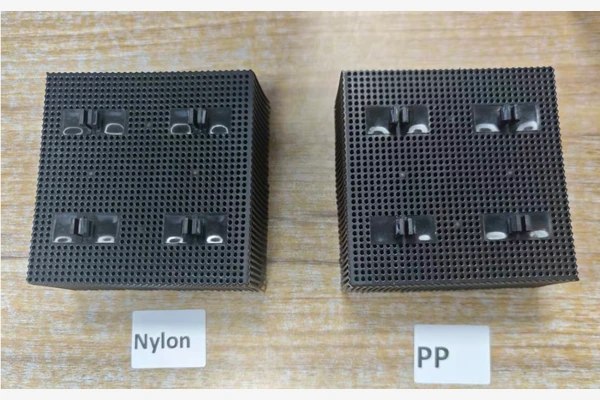
Choose the filament grade that matches your duty after the footprint and base already match — nylon for many high-abrasion multi-shift beds; polypropylene (PP/Poly) when the listing or humidity profile calls for it.
Both nylon and polypropylene are common thermoplastics in cutter beds. Engineering material comparisons such as Xometry’s polypropylene vs nylon guide (retrieved 2026-11-04) note that nylon is valued for mechanical strength and resistance to chemicals, fungi, and abrasion across several grades, while polypropylene often trades some durability for lower cost and different stiffness. That is general polymer guidance — not a cutter-bed lab test — so still match the footprint first.
Stak product FAQs add a practical humidity note used across live bristle PDPs: nylon can absorb moisture and may change stiffness in consistently humid rooms, while PP generally absorbs much less moisture. Stak normally selects materials to follow the corresponding original specifications; where a PP version is available, rooms with long rainy seasons sometimes ask for it after a sample check. Material references cited on those pages include BASF Ultramid (PA) product literature and LyondellBasell polypropylene primers.
Practical pick for cutting rooms
| Material | Best when | Watch-out |
|---|---|---|
| Nylon | High volume, abrasive or coated stacks, multi-shift lines when the OEM-corresponding listing is nylon | Confirm exact model footprint and base; watch humidity effects |
| Polypropylene (PP / Poly) | Lighter soft-goods duty, budget refresh cycles, or humid rooms when a matching PP listing exists | May wear faster on harsh abrasive stacks |
A soft nylon block with the wrong foot will rock or leave gaps. A correct-foot PP block on a light garment line can be the right buy. Ask for nylon or PP on purpose when you inquire — confirm the listed size, base, and material for the exact replacement. See live examples on the bristle product category.
When Should You Replace Bristle Blocks?
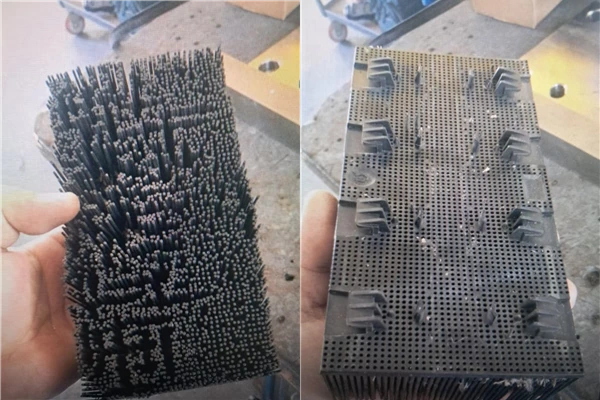
Replace bristle blocks when filaments are flattened, bald, or soft under hand pressure, when vacuum hold drops, or when cut edges wander after you rule out a dull blade — not when a calendar says so.
Use the wear checklist below to decide which areas to inspect, rotate, or replace.
The signal Stak buyers and techs trust most on the floor is simple: palm-press the track plus watch vacuum hold. If tips stay dented and top plies creep under film after you ruled out a dull blade and clogged ports, that zone is due.
Wear signals that matter
| Sign | What it means | First action |
|---|---|---|
| Flattened or angled tips | Repeated track wear | Rotate or replace that zone |
| Bald patches | Same rows cut too often | Replace worn rows / set |
| Soft feel under palm | Air leaking through the field | Replace; clean ports under the bed |
| Daylight through filaments | Seal is gone | Replace before the next critical nest |
| Fresh blade still wanders | Bed no longer supports the stack | Inspect blocks before more software tweaks |
| Serrated edges / size drift / collapsed surface | Classic late-stage wear | Replace; recheck plunge depth |
Why some beds die early
Three habits usually shorten life faster than “bad brand”:
- Blade depth too deep — tip chews filaments on every pass.
- Abrasive materials or high speed — coated and filled stacks scrub tips harder.
- Clogged vacuum ports — lint packs airflow paths under a bed that still looks “tall.”
High-volume rooms cutting abrasive goods may refresh sections about monthly. Lighter soft-goods rooms often stretch longer. Visual wear is the trigger. There is no single universal hour count that fits every plant. Keep tip entry shallow, keep the table level, then rotate hard-hit rows before the whole bed fails.
How Do You Match Bristle Block Size, Part Number, and Base Shape by Brand?
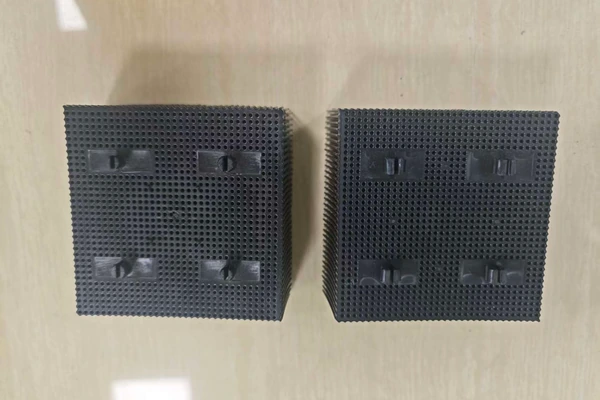
Match the old reference number, full machine model, overall L×W×H, and underside base shape (round foot vs square foot, perforated rim vs solid rim); never order by brand name or color alone.
Guessing by logo color creates returns. Stak’s bristle category FAQ is explicit: color is an identification aid, not a complete technical specification. For Gerber, the 1011273000 / 86875001 square-foot block and the 92910001 / 1011274000 round-foot block both measure 101.5 × 101.5 × 42 mm. For Lectra, the VT5000 / VT7000 block (130297 / 702583) measures 95 × 90 × 42 mm, while the FX block (131241 / 704234) measures 101.5 × 101.5 × 26 mm. For Bullmer, the listed D-series block measures 101.5 × 101.5 × 42 mm and the S90 / S90 Pro block (171344039) measures 100 × 50 × 42 mm. The two Takatori base versions both measure 100 × 50 × 49 mm. See the product links below for each fitment.
Fit steps before you order
- Copy every reference on the old block or packing slip (including dual codes).
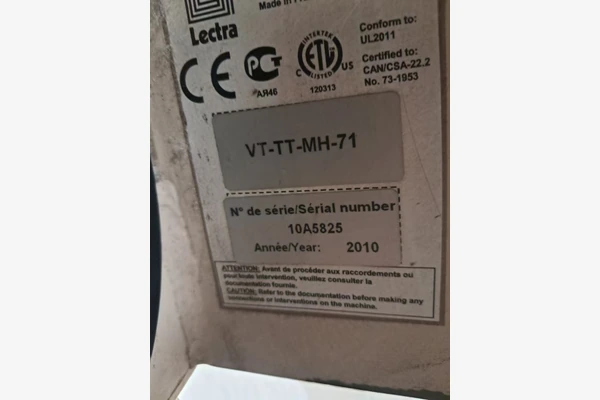
- Write the full cutter model from the nameplate or HMI.
- Measure length × width × height in millimeters.
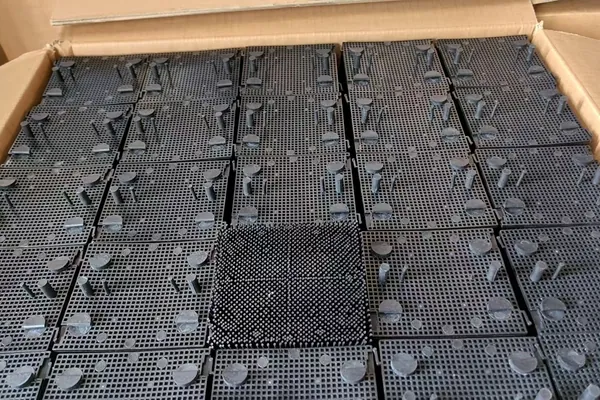
- Photograph the underside — similar tops can hide different feet.
- Note garment, upholstery, or automotive use, quantity, and delivery country.
If the stamp is gone, use the cutting machine part number lookup guide, then open brand categories such as Lectra, Gerber, or Bullmer as needed.
Stak catalog samples (compatible replacements)
Stak replacement specifications come from the linked product pages. OEM documents and other suppliers’ listings are identified separately. Where machine fit is unverified, the model is listed for identification only. Confirm the original block dimensions and underside before ordering.
| Brand | Models (listed) | References / Stak SKU | Size (mm) | Material / notes | Product |
|---|---|---|---|---|---|
| Bullmer | D8001, D8002, D8002S, D8003, D5001, XL7501 | 060548 / 60548 / 70144014 | 101.5 × 101.5 × 42 | Black nylon | View product |
| Bullmer | S90, S90 Pro | 171344039 | 100 × 50 × 42 | Black nylon | View product |
| Bullmer | S80, S100 | 170144065 | 101.5 × 101.5 × 42 | Black nylon | View product |
| Gerber | GT5250, GT7250, XLC7000, Z7, Paragon | 1011273000 / 86875001 | 101.5 × 101.5 × 42 | Black nylon, square foot | View product |
| Gerber | GT5250, GT7250, XLC7000, Z7, Paragon | 86875002 | 101.5 × 101.5 × 42 | White nylon, square foot | View product |
| Gerber | Atria GT, Atria 70, GT5250, GT7250, XLC7000, Z7, Paragon | 92911001 / 94970100 / 1011272000 / 1011272001 | 101.5 × 101.5 × 42 | Black poly, square foot | View product |
| Gerber | GTXL, S91, S93, GT7200, GT5200 | 92910001 / 1011274000 | 101.5 × 101.5 × 42 | Black poly, round foot | View product |
| Gerber | GT1000, 3200, 3250 | 96386003 | 101.5 × 101.5 × 26 | Blue poly | View product |
| Lectra | Vector 5000 / VT5000, Vector 7000 / VT7000 | 130297 / 702583 | 95 × 90 × 42 | Red nylon | View product |
| Lectra | Vector 2500 / VT2500 / VT25 | 130298 / 703493 | 50 × 50 × 21 | Red nylon | View product |
| Lectra | FX, FP, Q25, IX, FX72, FP72 | 131241 / 704234 | 101.5 × 101.5 × 26 | Black nylon | View product |
| Lectra | MX, MX9, iX6, iX9 | 131240 / 704233 / 127612 | 192 × 95 × 43 | Black nylon | View product |
| Lectra | MH, MH8, M88, iH5, iH8, Q50, Q80, M55, iQ50, MP9, MP6 | 131181 / 704186 | 192 × 95 × 43 | Black nylon | View product |
| OROX | iCut series, including iCut C600 (fit unverified) | 0802984 (Stak listing) | 52 × 51 × 43 | Nylon. Black and yellow bases differ. The machine brochure does not tie iCut C600 to this reference. | View product |
| Audaces | Neocut Bravo V7, V8, V9, V10 (OEM black block) | 0802984 | 52 × 51 × 43 (Stak); 50 × 50 × 53 (Audaces listing) | Audaces confirms the original black block for these four versions. The listed heights differ by 10 mm. Confirm how height is measured and compare the underside before selecting a Stak replacement. | View product |
| Cosma | Specific model unverified | 0802984 (Stak listing) | 52 × 51 × 43 | Nylon. Compatibility is listed at brand level. Match the old block and its base before ordering. | View product |
| YIN | HY-HC high-ply series (fit unverified) | STAK-YIN-100X50X50-NYLON (Stak SKU) | 100 × 50 × 50 (Stak); 100 × 50 × 42 (another supplier) | Stak lists black nylon. A supplier lists CH04-41 at 100 × 50 mm without an overall height. Confirm height and base on the old block before selecting a replacement. | View product |
| Eastman | Raptor, Talon 25, Talon 75 (Stak fit unverified) | STAK-EASTMAN-100X100X42-PP (Stak SKU) | 100 × 100 × 42 (Stak) | Black PP. The Raptor parts list identifies OEM blocks 67-27016 (blue) and 67-26616-WH (white). The Stak block has no verified cross-reference to either. | View product |
| Investronica | CV040/070 (fit unverified) | STAK-INVESTRONICA-100X100X38-NYLON (Stak SKU) | 100 × 100 × 38 (Stak); 99 × 99 × 39 (another supplier) | Stak lists black nylon. The machine listing confirms the CV040/070 model, but does not identify the correct block size. Compare the original block dimensions and base. | View product |
| Takatori | TAC-3VN, TAC-5VN, TAC-HV and TBR series (base fit unverified) | STAK-TAKATORI-100X50X49-NYLON-BASE-A / STAK-TAKATORI-100X50X49-NYLON-BASE-B (Stak SKU) | 100 × 50 × 49 (both Stak versions) | Black nylon. The perforated-rim (BASE-A) and solid-rim (BASE-B) bases are separate SKUs. Match the underside because the overall dimensions are identical. | Perforated-rim base · Solid-rim base |
Model and specification sources
- OROX · OROX iCut brochure
- Audaces · Audaces OEM
- YIN · YIN models · 42 mm listing · CH04-41 listing
- Eastman · Raptor parts list · Talon models
- Investronica · CV040/070 listing · 99 × 99 × 39 listing
- Takatori · Takatori catalog · TBR manual
Ask Stak to confirm (not listed as a standalone verified row above): any unreadable stamp, dual codes that do not match a live PDP, or look-alike tops with unknown feet. More brand families (KM/Hashima, TMING, YYC, AGMS, Morgan, IMA, Kuris, and others) appear in the bristle category — always open the live product page before ordering.
Hub links: bristle blocks · bristle category · part number lookup
How Do You Install, Rotate, and Maintain Bristle Blocks?
Install blocks flush and locked to the frame, rotate hard-hit rows on a schedule, clear debris every shift, and keep blade tip depth shallow so the next set lasts longer.
The one habit Stak wants every room to keep: recheck plunge depth after every material change, and vacuum the bed surface every shift. Replacement is inevitable. Premature replacement is optional.
Install checklist
- Lock out the cutter and release vacuum.
- Remove worn rows in a mapped pattern so you know which zones fail first.
- Clean ports and the frame pockets before new blocks go in.
- Seat each block so the base foot locks the same way as the neighbors — no rocking.
- Check that the bristle surface is level across joints within the cutter manufacturer’s tolerance.
- Restore vacuum and run a short test nest before a critical production cut.
Rotate and clean
- Vacuum the surface each shift; deep-clean ports on a fixed weekly plan in dusty rooms.
- Rotate front-to-back and move hard-hit rows to lighter zones.
- Recheck blade depth after each material change using the cutter manufacturer’s procedure.
- Inspect blocks whenever you inspect blades and grinding stones; they wear as a system.
- Keep a spare matched set on the shelf so downtime never waits on freight.
When cut quality drops, prove the bed before you rewrite the nest or blame the CAM file. A new blade on a soft bed wastes the blade and the fabric.
OEM vs Aftermarket Bristle Blocks: What Actually Has to Match?
What must match is geometry and duty: part reference or equivalent size, base foot, overall L×W×H, and filament grade for your workload — not the machine maker’s logo on the box.
Stak’s bristle FAQ is clear on the bristle blocks page: these are compatible replacements, not original machine-maker parts. Names such as Lectra and Gerber are for compatibility only. Stak is not affiliated with those manufacturers.
What has to match
| Must match | Why |
|---|---|
| Footprint L×W×H | Gaps leak vacuum and rock under the stack |
| Underside base / foot shape | Wrong foot will not seat or will leave high spots |
| Reference or verified equivalent | Dual codes and supersessions are common |
| Filament material for the duty | Nylon vs PP changes life and humidity behavior |
What does not have to match
- OEM box branding
- Filament color as a “model ID”
- Assuming one brand’s brick drops into another brand’s pocket
Compatible aftermarket blocks still need the same fit rules as OEM geometry. Use the part number to find the listing, then verify dimensions, base geometry, and filament grade for that exact replacement. Color myths waste time. Red, black, white, or blue can appear across families. Treat color as a hint at best, never as the order key. Measure, photograph the underside, and confirm the live product page.
What Should You Send to Get a Fast Bristle Block Quote?
Send all part references, machine brand and full model, L×W×H, underside photos, quantity, ship-to country, and nylon or PP preference so Stak can quote without a second round of questions.
Incomplete messages slow every supplier. A short pack fixes that. Stak’s hub FAQ says the same: send the part number, or brand and model plus dimensions; a photo of the worn block helps match the replacement.
Copy-paste inquiry block
- Part number(s), including dual codes if listed
- Cutter brand and full model
- Quantity (pcs or sets)
- Delivery / ship-to country
- Photos: top, side, underside
- L × W × H if readable marks are gone
- Material preference: nylon or PP
- Application: garment / upholstery / automotive seats
Then Stak can confirm against the bristle blocks hub and the bristle category and quote with fewer loops. If the stamp is weak, start with the part number lookup steps, then send photos.
Frequently Asked Questions
Are bristle blocks interchangeable between Lectra, Gerber, and Bullmer?
Do not assume yes. Match reference, model, dimensions, and base geometry. Brand and color alone are not enough.
How often should bristle blocks be replaced?
There is no single plant-wide month count. Use weekly inspection and wear signals. High-volume abrasive rooms refresh sooner; lighter soft-goods rooms often last longer. See the wear checklist in this guide.
Does blade depth really shorten bristle life?
Yes. Extra plunge into the filaments on every stroke is one of the most common reasons blocks die early. Use the blade depth specified for your cutter and material.
Should I buy nylon or PP?
Prefer the material that matches the live listing and your duty. Nylon is common on abrasive multi-shift beds when the footprint matches. PP can fit lighter duty or humid rooms when a matching PP SKU exists. Fit first, then material.
What if the part number is unreadable?
Send brand, model, top and underside photos, overall measures, quantity, and delivery country. Include any remaining marks on the old block.
Conclusion
A good bristle bed is quiet infrastructure: vacuum holds, the knife plunges safely, and edges stay true. Inspect weekly. Replace by wear signals. Order by part number, model, size, and base — then set depth, clean ports, and rotate so the next set lasts longer.
Continue learning
- Bristle blocks for auto cutters (hub)
- Bristle product category
- When should you replace cutting table bristle blocks?
- How do you find your automatic cutter part number?
- Lectra parts · Gerber · Bullmer
Ready to restock? Send part number, model, L×W×H, underside photos, quantity, and ship-to country — Stak will match a compatible replacement and quote. Questions about the company or shipping? See About Stak or Contact.