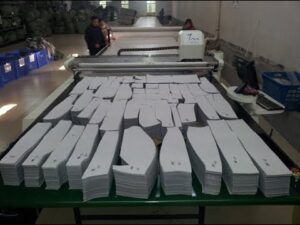
You order a blade. The new one does not fit. Your line stops. One wrong code wastes days.
An automatic cutter part number is a reference used to identify or cross-reference a replacement part. Find it on the part, packaging, invoice or machine manual, then confirm the machine model, revision and physical fit before ordering.
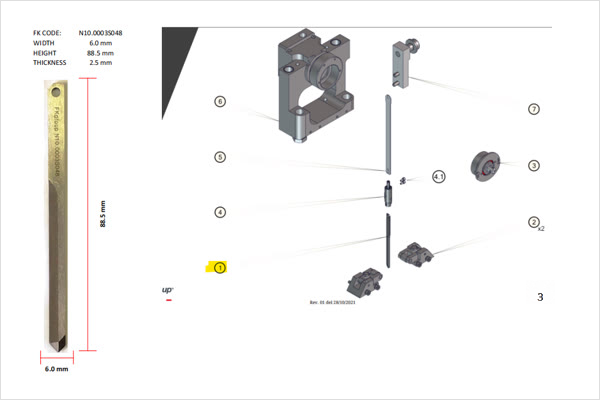
FK blade N10.0003S048 and a cutting-head diagram.
Start with the complete number, including letters, leading zeros and suffixes. Search the automatic cutter spare parts catalog or send the number and machine details to Stak for a compatibility check.
How to find a cutter part number
- Check the part itself for a stamped, engraved or printed code.
- Check the packaging label, previous invoice or maintenance records.
- Find the assembly in the parts manual for your exact machine and revision.
- Copy every number and suffix, including any legacy or alternate reference.
- Cross-check the part against the machine model, dimensions, mounting details and supplier listing.
What Is the Item Number of a Cutter Part?
A cutter holds thousands of parts. Many look the same. Guessing fails.
A cutter part number, sometimes called an item number, is a manufacturer or supplier reference used to identify a component. Check its source and the machine application before ordering.
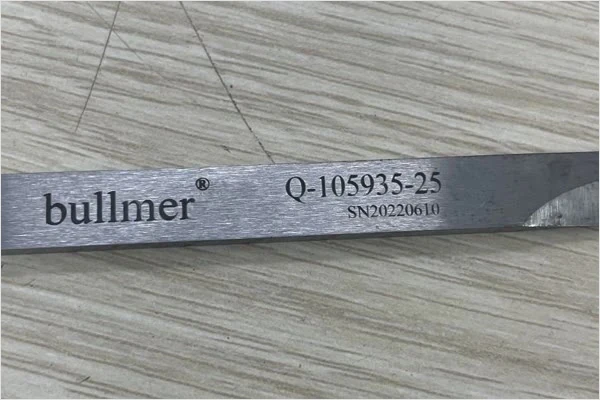
Bullmer blade marked Q-105935-25.
Why one code beats a long description
An automatic cutter can carry thousands of parts. Some lines hold even more across the full life of the machine. Blades, bristle blocks, grinding stones, and metal fittings often share a similar shape. Your eye cannot tell them apart.
A part number narrows the search and helps identify the intended component. A reference alone does not prove that an aftermarket item has the same material, color, quality or fit. Check the machine model, revision, dimensions and mounting details.
A short inquiry with the part number can reduce back-and-forth. Stak lists replacement parts for Lectra, Gerber and Bullmer cutters. Include the machine model and photos if the listing or fit is uncertain.
| What you send | What it helps identify | Result |
|---|---|---|
| Part number only | Identifies a candidate reference | Starting point; verify application |
| Photo only | Shape and wear | Slow match |
| Brand + model + photo | Narrower search | Better, still slower than a code |
Treat the part number as the spare’s ID. That is the cleanest path from need to quote.
What Does a Cutting Machine Part Number Usually Look Like?
Codes look simple. Brands still follow different patterns.
Cutter part numbers can contain digits, letters, punctuation and suffixes. Their format varies by manufacturer, product and revision; digit count alone cannot establish a brand or guarantee a match.
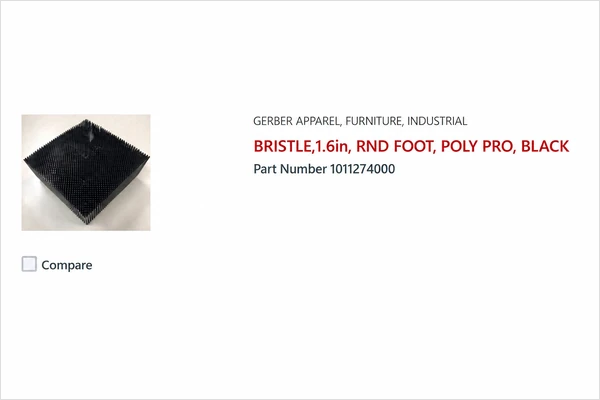
Illustrative example of a Gerber bristle block listing and part number.
Brand patterns I see most often
I do not ask buyers to memorize every rule. I ask them to copy the code exactly as printed. Still, it helps to know the usual shape. The rows below are examples. Always check the nameplate and the manual.
| Brand | Typical look | Example (illustrative) | Tip |
|---|---|---|---|
| Gerber | Formats vary; listings may include a legacy number | 93298001 / 93298000; 1011274000 | Send every code printed |
| Lectra | Numeric and alphanumeric references vary | 801269, 117930, 131181 | Add the machine model |
| Bullmer | Some listings show more than one reference | 060548 / 60548 / 70144014 | Give all codes when listed |
| FK | Letters + digits, often Nxx.xxxxS… | N10.0003S048, N09.0002S422 | Copy the full string |
| Kuris | Formats vary across parts | 24419, 49075, 24306 | Confirm with model and photo |
Some Bullmer trade listings show a shorter number next to a 701-series reference. Blade listings can also include a thickness suffix. Copy both references and every suffix as printed.
For a concrete example, Stak lists a Bullmer bristle block under 060548 / 60548 / 70144014. These are references on that listing; check its model, dimensions and base connection against the part in hand.
Digit length alone is not a unique key. Add the brand and model so Stak can check the likely spare and prepare a quote.
How Do You Find the Exact Part Number on the Machine or in the Manual?
The best code is the one printed on the part. The next best sits in the OEM manual.
Check the part face, the pack label, the invoice line, or the exploded drawing in the OEM parts manual; then send that exact string to your supplier.
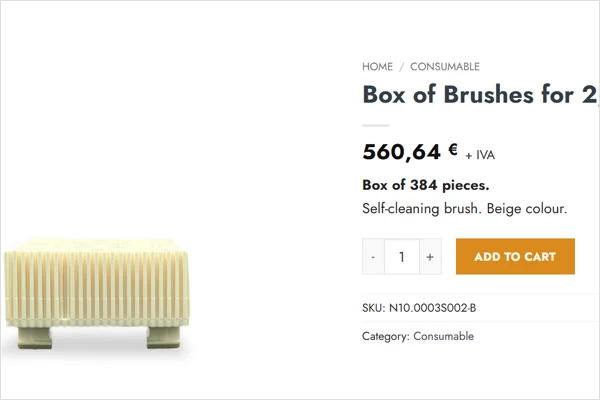
FK brush packaging with SKU N10.0003S002-B.
A simple search order that works on the floor
I start on the part itself. Blades often carry the code on the edge or face. Some grinding parts and metal fittings show stamped or printed marks. If you see it, photograph it. That photo ends most debates.
Next I check packing, labels, and invoice lines. Old boxes still save many orders. Then I open the OEM parts manual for that cutter model. The exploded drawing shows the station and the code next to the drawing. You can mark the spot on the drawing and send that page. Both sides then share the same reference.
| Source | How clear is it? | What to do |
|---|---|---|
| Marking on the part | Best | Photo + copy the string |
| Pack / label / invoice | Strong | Keep the line text |
| OEM exploded drawing | Strong | Mark the position and send the page |
| HMI or spare list | Useful | Export or screenshot the line |
If the code is on the part, you win. If not, the manual still gives you a shared map. That map is how factories and suppliers double-confirm the same spare.
How Do You Identify the Part Number Without a Product Manual?
No manual. No stamp. You still have a path.
Photograph the machine nameplate, the part, and its station; add safe size notes; then Stak or the OEM can match the spare from brand, model, and measures.
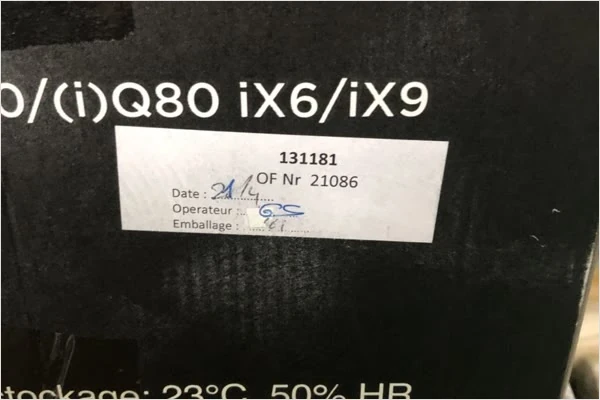
Lectra packaging label showing part number 131181.
What I ask buyers to shoot when the book is gone
First, shoot the metal nameplate on the machine. That plate shows the model, power data, and build date. It tells us which catalog world we are in. Second, shoot the worn part from more than one angle. Third, shoot the station where it sits: knife head, bristle bed, or grinding unit. Context stops wrong matches.
Then measure what you can do safely. Length, width, thickness, and bore help a lot on metal fittings. Write the numbers next to the photos. Do not force a fit if a part is sharp or still mounted in a risky way.
| Shoot or note | Why it matters |
|---|---|
| Nameplate | Locks brand and model |
| Full part photos | Shows shape and wear |
| Station / position | Shows which unit it serves |
| Length / width / thickness / bore | Separates look-alike parts |
With that pack, Stak can often match the code even when the stamp is gone. You move from “unknown metal” to a clear quote and the next talk on price and lead time.
Why Do Some Cutter Parts Have Two or Three Part Numbers?
One spare. Two labels. Buyers get confused. There is a reason.
A part can appear under multiple references, such as a Bullmer listing with several codes or a Gerber listing with current and legacy numbers. Record every field and confirm which one applies to your machine.
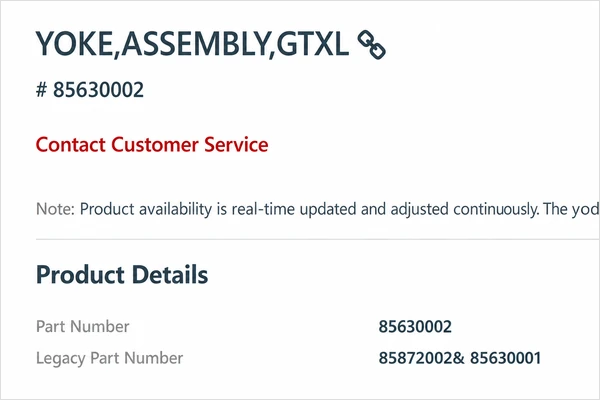
Illustrative example of current and legacy Gerber part numbers.
Dual systems, revisions, and kits
A Bullmer part listing may show more than one reference, as in the 060548 / 60548 / 70144014 example above. Copy all the references and compare the part and machine details; do not assume every short number maps to a particular 701-series code.
Gerber eStore listings can show both a Part Number and a Legacy Part Number. For example, Gerber’s roller listing shows 93298001 and legacy 93298000, along with applicable machine models. Copy both fields and confirm the relevant machine. Some other manuals distinguish order numbers from identification marks; follow the instructions for your exact machine.
| Case | What you see | What I send |
|---|---|---|
| Bullmer dual list | Short code + 701xxxxx | Both codes + model |
| Gerber revision | Current + Legacy | Both numbers |
| Kit / substitute | Extra suffix or new code | Full string as printed |
| Three-way list (example) | 060548 / 60548 / 70144014 | All three + size check |
If any side is unsure, go back to the nameplate, the station photo, and the size notes. That set still settles the match when codes disagree.
Why Do Some Products on the Stak Website Have No Part Number?
Mature brands show clean codes. Rare CNC parts may not.
Some replacement parts are listed by reference number, while others may have no known number. For an unnumbered part, send the brand, model, nameplate, photos and measurements to help identify it.
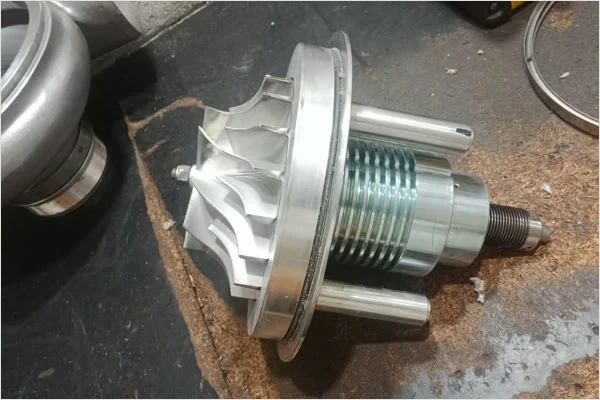
Unmarked cutter assembly for identification.
Mature catalogs versus custom metal
For Gerber, Lectra, Bullmer, Yin, and FK, the spare world is mature. Factories produce at scale. Code systems are stable. Stak can map code, English name, and fitted models and show them in the shop. Buyers can search and pick with less friction.
For an uncommon or custom metal component, the OEM reference may be unavailable. Browse the parts catalog by machine brand or component type, and send the machine model, nameplate, part photos and dimensions for a compatibility check.
| Catalog type | Code on site? | How you order |
|---|---|---|
| Common brand spares | Often | Search code or model pages |
| Custom / rare CNC metal | Often no | Nameplate + photo + measures |
Use the code when the site shows one. When it does not, use the machine truth: plate, photo, and size. That is how rare parts still move without guesswork.
Do OEM and Aftermarket Parts Use the Same Part Number?
Buyers fear a fake code. They also fear a high OEM price.
Aftermarket suppliers often use an OEM part number as a cross-reference, but matching references alone do not guarantee fit, material, quality or origin. Check the machine application and physical specifications before ordering.
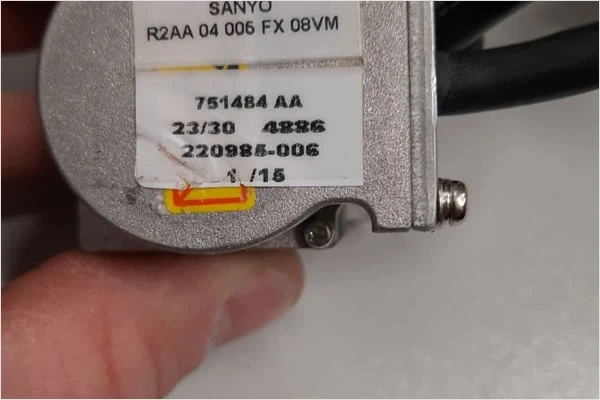
Sanyo motor nameplate with model and serial codes.
How I use the OEM code with Stak parts
When a buyer asks for a Lectra or Gerber spare, the OEM part number is a useful starting point. An aftermarket blade or bristle block may be listed against that reference. Confirm dimensions, mounting and machine configuration before ordering.
The code does not by itself tell you the steel grade, the nylon mix, or the QC process. Two sellers can list the same part number and ship different quality. I compare samples, wear life, and packing notes after the code match is clear. For warranty talks with the machine maker, some plants still prefer OEM boxes. For daily consumables, many rooms use matched aftermarket parts once the fit is proven.
| Question | Short answer |
|---|---|
| Does aftermarket invent a new part number? | Often no; it cross-references the OEM code |
| Does the same code mean the same quality or guaranteed fit? | No; verify the supplier, material, dimensions and application |
| What do I send Stak? | OEM code + model + photo if you have doubt |
So I treat the OEM part number as the bridge. Then I choose OEM or aftermarket on price, lead time, and how critical that station is.
Can You Order From Size Alone If the Part Number Is Missing?
The stamp is gone. You only have a ruler.
Yes, you can often start a match from length, width, thickness, and mount shape, then confirm the likely part number against brand and model before you place the order.
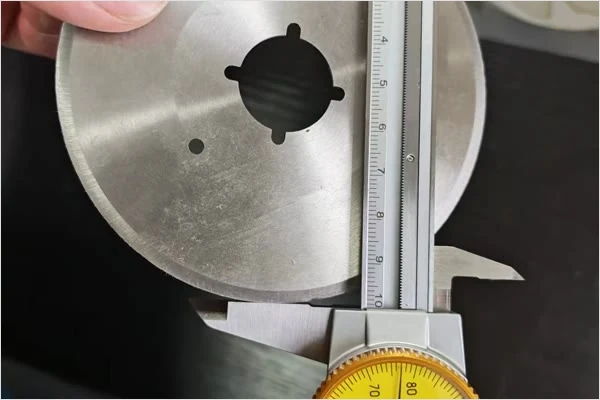
Measuring a circular cutter blade with a caliper.
Size tables help; they do not replace a final check
Blade catalogs may associate dimensions with a reference, but measurements and listings can differ by variant. Compare the dimensions, mounting details and machine application on the specific cutter blade listing before ordering.
I still ask for brand and model. Two blades can share one outer size and use a different hole or angle. Bristle blocks can share a top size and use a different foot (round or square). Measure L × W × T. Photograph the shank or base. Then Stak can point to the part number that fits and quote with less risk.
| You have | Next step |
|---|---|
| Size only | Add brand, model, and mount photo |
| Size + brand | Cross-check chart and catalog |
| Size + brand + model + photo | Strong starting point for a supplier compatibility check |
Size alone can open the door. Brand, model, and a clear photo close the deal.
What Is the Difference Between a Maintenance Kit Code and a Single Part Number?
A kit box shows one big number. Inside you see many small ones.
A maintenance kit (MTK) code identifies a package of service parts; where individual component numbers are available, use the kit contents list to identify a single replacement.
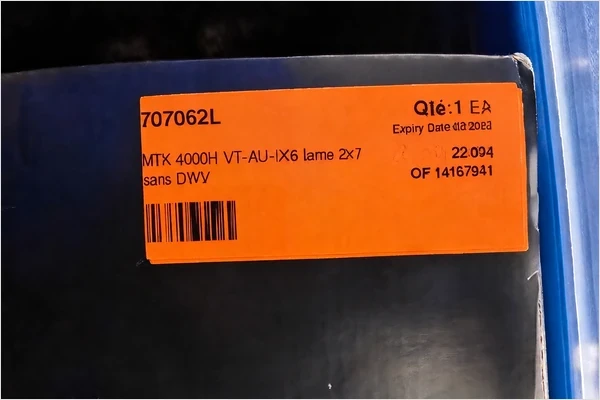
Lectra MTK 4000H maintenance kit label, part number 707062L.
How I read 500H, 2000H, and 4000H kits
Some maintenance kits are identified by a service interval, such as the 4000H label shown above. The kit code identifies the set, not necessarily an individual roller or belt. Lectra’s consumables and parts guide describes maintenance kits tailored to different machines; check the exact kit contents and applicable model.
I open the kit list and map each line to its single part number. Then a buyer can reorder only what failed. Gerber pack marks like -PKG follow a similar idea: the pack code is for the bundled offer; the legacy or current part number still identifies the core piece.
| Code type | What it buys | When I use it |
|---|---|---|
| Kit / MTK / -PKG | A set for a service interval or bundle | Full PM job |
| Single part number | One spare | Spot replacement |
| Supersession / substitute | New code for a stopped old code | Old stock is gone |
If your kit label is the only number you have, send a photo of the label and the machine model. Stak can help identify individual components where the necessary information is available.
What Should You Send for a Fast and Accurate Quote?
Missing fields slow every supplier. A short checklist fixes that.
Send part number (all variants), brand, model, quantity, delivery country, and photos or sizes when the stamp is weak; that pack lets Stak quote the right spare fast.
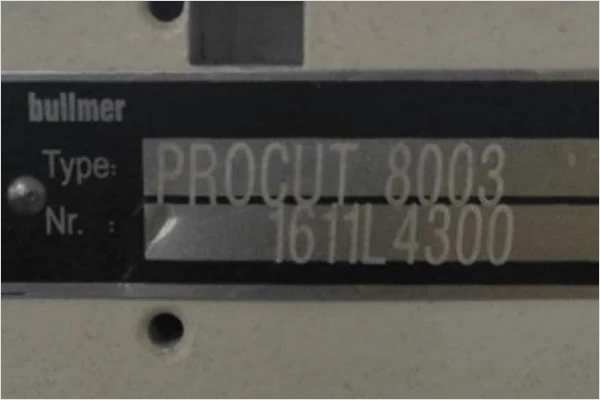
Bullmer PROCUT 8003 machine nameplate.
My standard inquiry list
You can paste this checklist into an email or WhatsApp message to reduce follow-up questions.
- Part number(s), copied exactly, including leading zeros and letters
- Machine brand and full model
- Quantity and unit (pcs / sets)
- Delivery country and city if known
- Photo of the old part and the nameplate
- Size notes if the stamp is worn
- Note if you need OEM-only or accept matched aftermarket
| Field | Why it matters |
|---|---|
| Part number | Fastest lock on the SKU |
| Brand + model | Stops cross-brand mix-ups |
| Quantity | Price breaks and stock plan |
| Delivery country | Freight and lead time |
| Photos / sizes | Backup when codes conflict |
Send that list once. You get a cleaner quote and fewer wrong shipments.
FAQ
Is digit length enough to identify a part?
No. Lectra and Kuris can both sit near five digits. Always add brand, model, and a photo when you can.
What if my Bullmer spare shows two or three codes?
Send every code on the page or label. Lists such as 060548 / 60548 / 70144014 often point to one spare. Still check size and base before you order.
What if Gerber shows Legacy and a new Part Number?
Send both. The new number is usually the current order key. The legacy number helps cross-check old stock and manuals.
What if the part has no stamp and I lost the manual?
Shoot the nameplate, the part, and the station. Add safe measures. Stak can often match from that set.
Are OEM and aftermarket part numbers different?
Many aftermarket listings use an OEM reference for cross-checking, while others use their own codes. Verify the application and physical fit; quality also depends on the manufacturer.
Can I order with size only?
You can start with size. Add the brand, model and a mounting photo so the supplier can check the likely part number and fit.
Does one kit code replace every single part number?
No. A kit code identifies the set. Consult its contents list for the individual part numbers that are available for separate ordering.
Conclusion
Copy every part number you see, including suffixes. If codes conflict or are missing, send the machine nameplate, part photos, measurements, quantity and delivery country. Contact Stak for a compatibility check and quote.
Machine brand names identify compatibility and do not imply affiliation with or endorsement by those manufacturers.