
Felt Conveyor Belts
for Digital Cutting Machines
Replacement felt belts for single-ply and low-ply cutting tables — Zünd, Esko Kongsberg, iEcho, Summa, Aristo, Atom, Bullmer, Kuris and more. Cut to your table size, with a free splice in any of ten shapes.

Browse every felt belt we cut
315 belts listed by machine model and OEM part number, with width, length and available thickness. Find your machine, check the size, request a quote.
Find the belt for your machine
Pick your cutter brand to see belts matched to each model and table size. If your model isn't listed, send us the old belt's dimensions and we will cut it to fit.
Seven grades, matched to your vacuum and your material
Airflow is what holds the workpiece down. Too open and you lose vacuum through the belt; too closed and the vacuum cannot pull through at all. Each grade below is a different balance of thickness, density and permeability.
| Series | Construction | Thickness | Weight | Hardness | Airflow L/dm²/min @200 Pa |
|---|---|---|---|---|---|
| F-40D | Double-sided nap | 4.0 ±0.2 mm | 2,100 g/m² | 70 ±5° | 110 |
| FH-40D | Double-sided, hard | 4.0 ±0.2 mm | 1,800 g/m² | 80 ±5° | 200 |
| FR-40D | Mesh-reinforced, double-sided | 4.0 ±0.2 mm | 2,200 g/m² | 70 ±5° | 30 |
| FR-25D | Mesh-reinforced, double-sided | 2.5 ±0.1 mm | 1,500 g/m² | 70 ±5° | 50 |
| FR-55D | Mesh-reinforced, double-sided | 5.5 ±0.2 mm | 3,000 g/m² | 70 ±5° | on request |
| F-40S | Single-sided nap | 4.0 ±0.2 mm | 1,700 g/m² | 70 ±5° | 200 |
| FR-40S | Mesh-reinforced, single-sided | 4.0 ±0.2 mm | 1,800 g/m² | 70 ±5° | 50 |
Catalogue hardness range across all grades: 55–90° (Shore A). Working temperature −15 to +110 °C continuous. Minimum pulley diameter 100 mm. Colours: grey, white, green, blue, custom.
When to choose mesh-reinforced
Long tables and heavy starting loads. The internal mesh limits stretch, so the belt keeps its length and does not need re-tensioning as often.
When to choose high airflow
Thin, lightweight or porous materials that need a strong hold-down through the belt. Higher permeability means more vacuum reaches the surface.
When to choose low airflow
Small parts, dense layouts and high-vacuum pumps. Less air escapes sideways, so small pieces stay put while the knife passes.
Ten splice options, free of charge
Belts are supplied open-ended with the splice teeth already cut, and joined into a loop on site. Tell us the shape you need and we cut it at no extra cost — including matching the splice the machine was built for.
 DiamondStandard
 Arc
 Round
 Small diamond
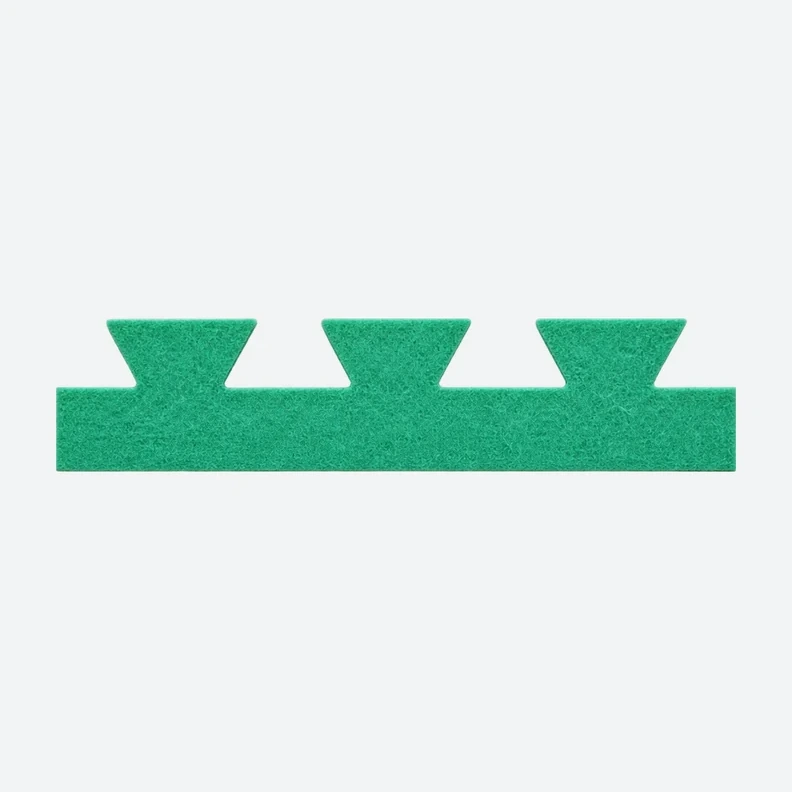 DovetailTrapezoid
 Double trapezoid70 mm
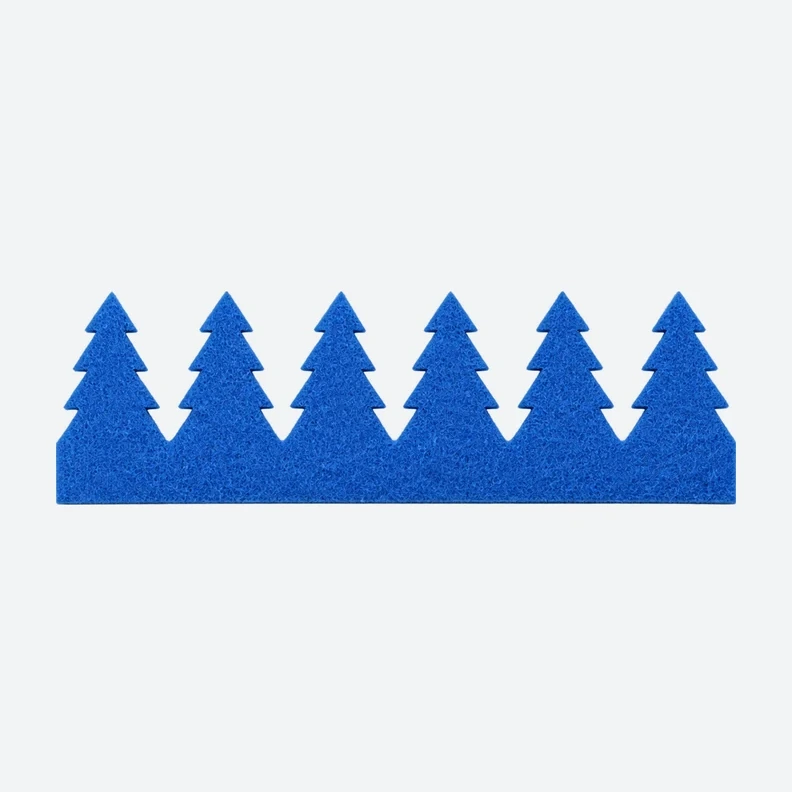 Tree60 mm
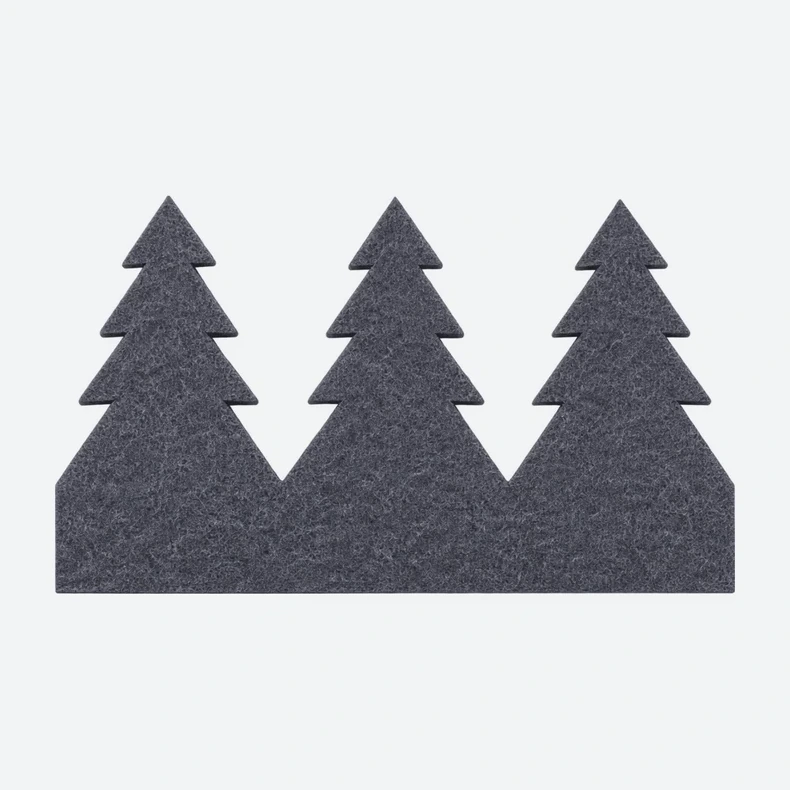 Christmas tree105 mm
 Christmas tree200 mm
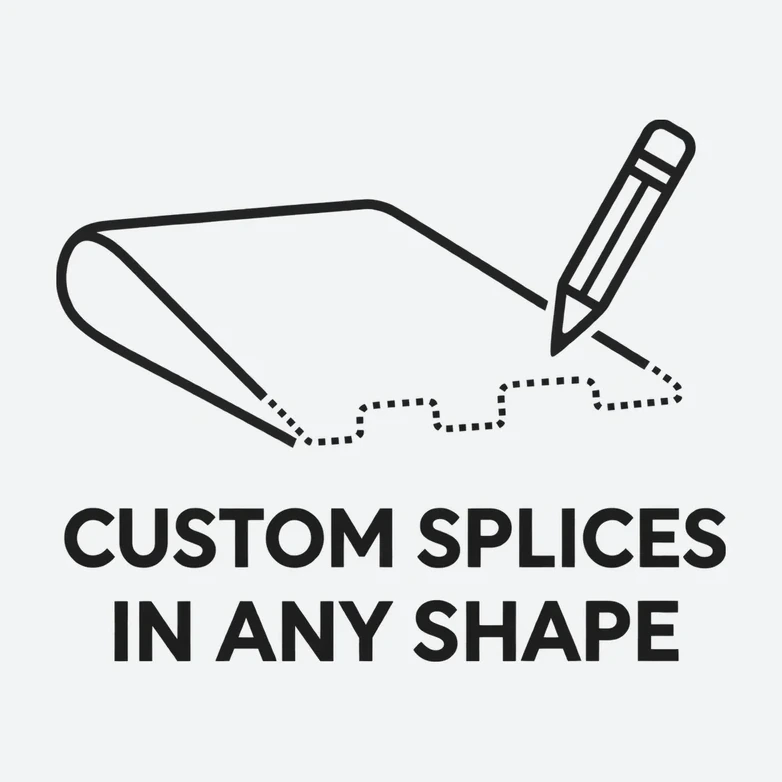 CustomAny shape
Images show splice profiles for identification. Exact tooth dimensions are confirmed against your measurement or drawing before production.
Three measurements and we can cut it
Measure the belt
Lay the old belt flat and measure its total length, its width, and its thickness with a caliper. A photo of the worn splice helps us match the profile.
Pick a grade
Tell us the machine model and what you cut. We will recommend the thickness and airflow that suit your vacuum pump and material.
Fit it on site
The belt arrives open-ended with the splice cut. Align the teeth, apply contact adhesive, press the joint and let it cure fully before running.
Built for the cut, not just for the conveyor
Cut resistance without shedding
The needle-punched surface resists the knife and does not throw fibres or dust into the vacuum system or onto the workpiece.
Uniform thickness
Held to ±0.2 mm on 4.0 mm grades, so depth settings stay consistent across the whole table instead of drifting from one end to the other.
Double-sided
Most grades are napped on both faces. When one side wears, turn the belt over and run the other — the same belt, twice the service.
Wide tables, joined panels
A single felt sheet goes to 3,500 mm. Wider belts are built from two panels joined edge to edge — for example 5,345 mm split as 2 × 2,672 mm.
Splices at no extra cost
Ten profiles, including customs cut to drawing. No surcharge for a puzzle joint, and no minimum order on the splice itself.
Cut to your size
Any length from 0.5 m to 110 m and any width to 3,500 mm in one sheet, with guide bars, marking and surface treatment available on request.
Before you order
How do I measure my existing belt?
Cut the old belt open at the splice and lay it flat. Measure the full length end to end, the width, and the thickness with a caliper in three places. Send the three numbers plus your machine brand and model; if the belt is still on the machine, measure the table length and the pulley diameter instead.
Does the belt come as a closed loop?
No. Belts are supplied open-ended with the splice teeth already cut, because a closed loop cannot be fitted around the table frame. You join it into a loop on the machine during installation.
Do you supply the adhesive?
We do not ship adhesive — solvents and glues are restricted in air and sea freight, and a consignment held at customs costs more time than it saves. We will tell you which type of contact adhesive to use and where to source it locally.
How long does the joint take to set?
Follow the adhesive manufacturer's instructions. As a rule, let the joint cure fully before the belt is put into service — running a belt on a joint that has not fully cured will pull it apart.
Which thickness should I choose?
Match the thickness the machine was built for first — it affects the height of the cutting surface relative to the knife and the vacuum chamber. 2.5 mm is common on lighter tables; 4.0 mm on most single-ply cutters; 5.5 mm on heavy or high-vacuum installations. Tell us the model and we will confirm.
Can you supply belts wider than 3,500 mm?
Yes. A single felt sheet is limited to 3,500 mm, so anything wider is built as a joined panel: either two full sheets cut to the needed widths, or the target width split evenly and bonded. We make belts for tables over 5 m wide this way.
How should I store a spare belt?
Keep it in a dry, cool place away from direct sunlight, UV and dust. Do not squeeze or stack heavy items on it, and do not store it in a humid area — moisture affects the felt and the adhesive.
How often should a felt belt be replaced?
There is no fixed interval — it depends on what you cut, how much you run and how the knife is set. Replace it when the surface is visibly worn through, when hold-down weakens on small parts, or when the belt stops tracking straight.
Send us your dimensions
Machine brand and model, length × width × thickness, and the splice shape you need. We will come back with a price and a lead time — and tell you if a different grade would serve you better.
Stak is an independent supplier of replacement parts and is not affiliated with, authorised by or endorsed by any machine manufacturer. Brand names and model numbers are used solely to indicate compatibility. Zünd, Esko, Kongsberg, iEcho, Summa, Aristo, Atom, Bullmer, Kuris, Comelz, Teseo, Dyss and all other trademarks are the property of their respective owners. Specifications are typical values and may be adjusted after confirmation of your application.


